
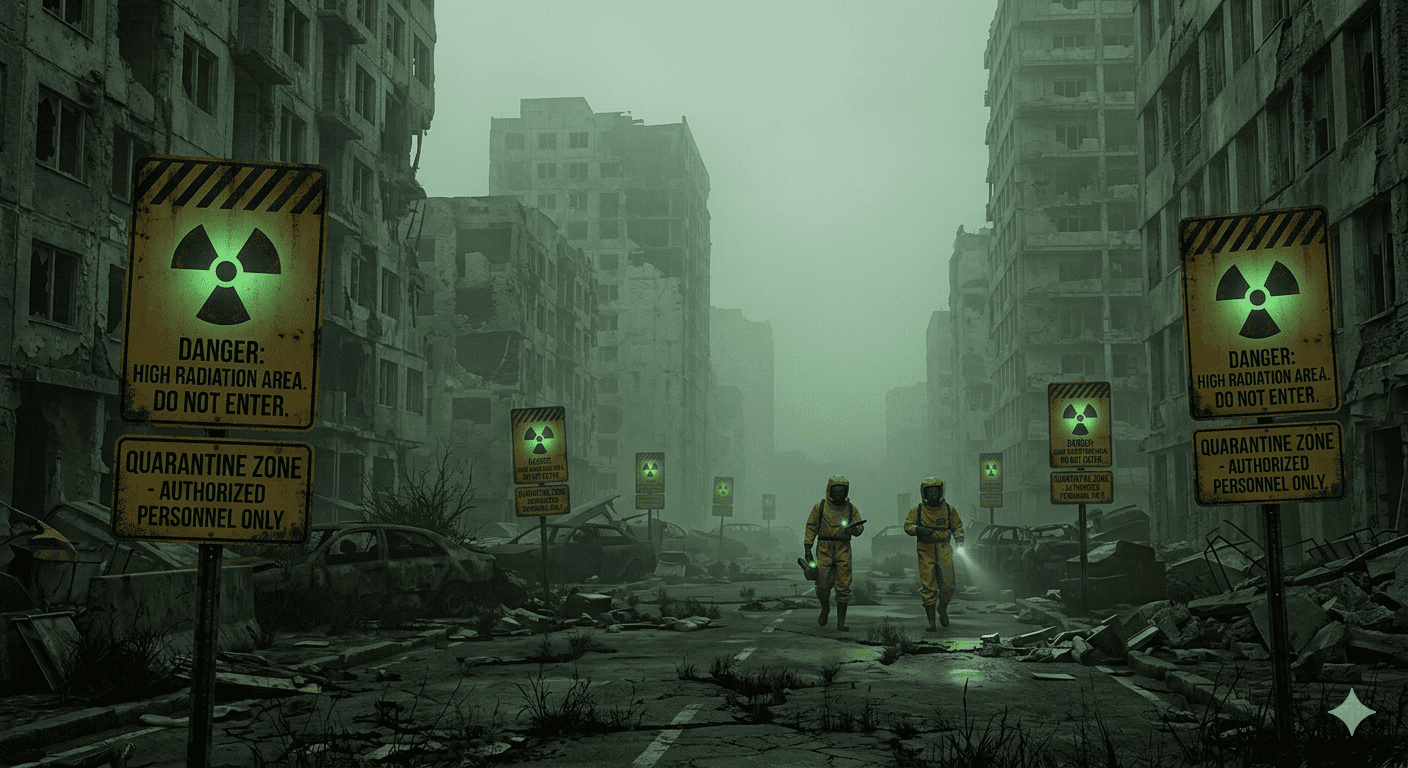
A Science Fiction Story
Introduction
In the mid-twenty-first century, humanity had achieved remarkable technological progress. Cities floated above oceans, artificial intelligence guided global industries, and space colonies had begun forming on the Moon. Yet beneath this progress remained an ancient human flaw—conflict.
Nations still competed for power, influence, and resources. Nuclear weapons, first developed in the twentieth century, had grown far more destructive. Each superpower possessed thousands of warheads capable of destroying civilization many times over.
For decades, world leaders promised that nuclear weapons existed only for deterrence. But one day, a chain of mistakes and mistrust pushed humanity past the point of no return.
What followed would become known as The Last War.
Contents
The Spark That Ignited the World
The crisis began with a regional conflict between two rival nations. A military satellite malfunctioned and mistakenly detected a missile launch that never actually occurred. Within minutes, automated defense systems alerted national command centers.
Panic spread through military networks.
Leaders had only minutes to decide whether the warning was real or false. In the fog of uncertainty, one nation launched a “defensive strike”—a small group of nuclear missiles meant to neutralize the perceived threat.
But once the first missiles were launched, there was no turning back.
Early warning systems across the world detected the launches and interpreted them as the beginning of a full-scale nuclear attack.
Within thirty minutes, hundreds of nuclear missiles were flying across the planet.
The age of humanity had entered its final chapter.
The Firestorm of Cities
The first explosions struck major cities—Washington, Moscow, Beijing, London, Paris, New Delhi, and many others.

In a single flash brighter than the sun, entire metropolitan regions vanished.
The blast waves traveled faster than hurricane winds, flattening buildings and infrastructure. Temperatures at the center of the explosions reached millions of degrees, instantly vaporizing everything within several kilometers.
Millions died within seconds.
But the destruction did not stop with the explosions.
The heat ignited massive firestorms. Entire cities burned, creating towering columns of smoke that rose high into the atmosphere. Asphalt melted, steel structures collapsed, and forests miles away ignited like dry paper.
Communication networks collapsed. Satellites were destroyed. Governments lost contact with each other.
Within a few hours, the modern world ceased to function.
The Birth of Nuclear Winter
As thousands of cities burned, enormous clouds of smoke and soot spread into the upper atmosphere. These dark particles blocked sunlight from reaching the Earth’s surface.

Scientists had predicted this phenomenon decades earlier. They called it nuclear winter.
Within weeks, global temperatures dropped dramatically.
Sunlight faded into a gray, permanent twilight. Crops failed across continents. Rivers and lakes began freezing even in regions that had once been warm.
Animals starved as ecosystems collapsed. With agriculture destroyed, the surviving human population faced severe famine.

Humanity had survived the explosions, but now it faced a slower and more merciless enemy: planetary climate collapse.
The Silent Death of Oceans
While the land froze, the oceans began changing as well.
Radioactive fallout contaminated coastlines and rivers. Heavy metals and nuclear particles flowed into the seas. Marine ecosystems—already weakened by climate change and pollution—began dying.
Coral reefs vanished.
Fish populations collapsed.
Plankton, the microscopic organisms responsible for producing much of Earth’s oxygen, were severely affected by the lack of sunlight.
Within decades, the planet’s oxygen cycle began to weaken.

The Earth itself was slowly suffocating.
The Last Survivors
Small groups of survivors remained scattered across the planet.

Some lived in underground bunkers originally built by governments and wealthy corporations. Others hid in remote mountain regions far from major targets.
One such group lived beneath the frozen ruins of a former research facility in Antarctica.
Their mission was simple: record the final history of humanity.
They preserved books, scientific data, and recordings of human culture. They believed that someday, perhaps thousands of years later, intelligent life might evolve again and discover their archives.
The survivors knew they could not rebuild civilization.
The planet was simply too damaged.
Instead, they focused on remembering.
The Final Generation
Over the next several decades, the human population continued to decline. Radiation sickness, starvation, and harsh climate conditions slowly eliminated the remaining communities.
Children born in the bunkers often suffered genetic mutations caused by radiation exposure. Medical supplies ran out. Technology failed without replacement parts.
Eventually, even the most advanced shelters began losing power.
One by one, the last human outposts went dark.
The final message recorded in the Antarctic archive was simple:
“We were brilliant, creative, and capable of extraordinary things. But we could not overcome our own fear and anger. If another civilization finds this message, learn from our mistakes.”

Shortly after that recording, the last known humans disappeared.
A Silent Planet
Centuries passed.
Radiation levels slowly decreased. Forests began returning to abandoned cities. New species evolved to survive the harsh climate conditions.
But the dominant species that once built skyscrapers, computers, and spacecraft was gone.
Earth had survived.
Humanity had not.
From space, the planet still looked beautiful—blue oceans, white clouds, and green continents. Yet no lights shone from the night side of the world.

The era of human civilization had ended with the push of a few buttons.
Conclusion
This fictional story reflects a very real possibility that scientists and historians have long warned about. Nuclear weapons possess the power to destroy not only nations but the entire global ecosystem.
The lesson is clear: technological power without wisdom can lead to irreversible consequences.
Humanity’s future depends not only on scientific progress but also on cooperation, responsibility, and peace.
Because in a nuclear war, there are no winners—only a silent planet left behind.

Diploma in Lab Technician (DMLT)
Paramedical Board, Delhi, Govt. of India
(Reg. No. REG/23/41/1391)
Dedicated and detail-oriented Lab Technician with hands-on experience in diagnostic
testing, sample collection, and laboratory procedures. Seeking a challenging role in a
reputable healthcare organization where I can utilize my skills and contribute to accurate
and efficient patient care.
“Each health article undergoes professional medical review by experienced doctors.”